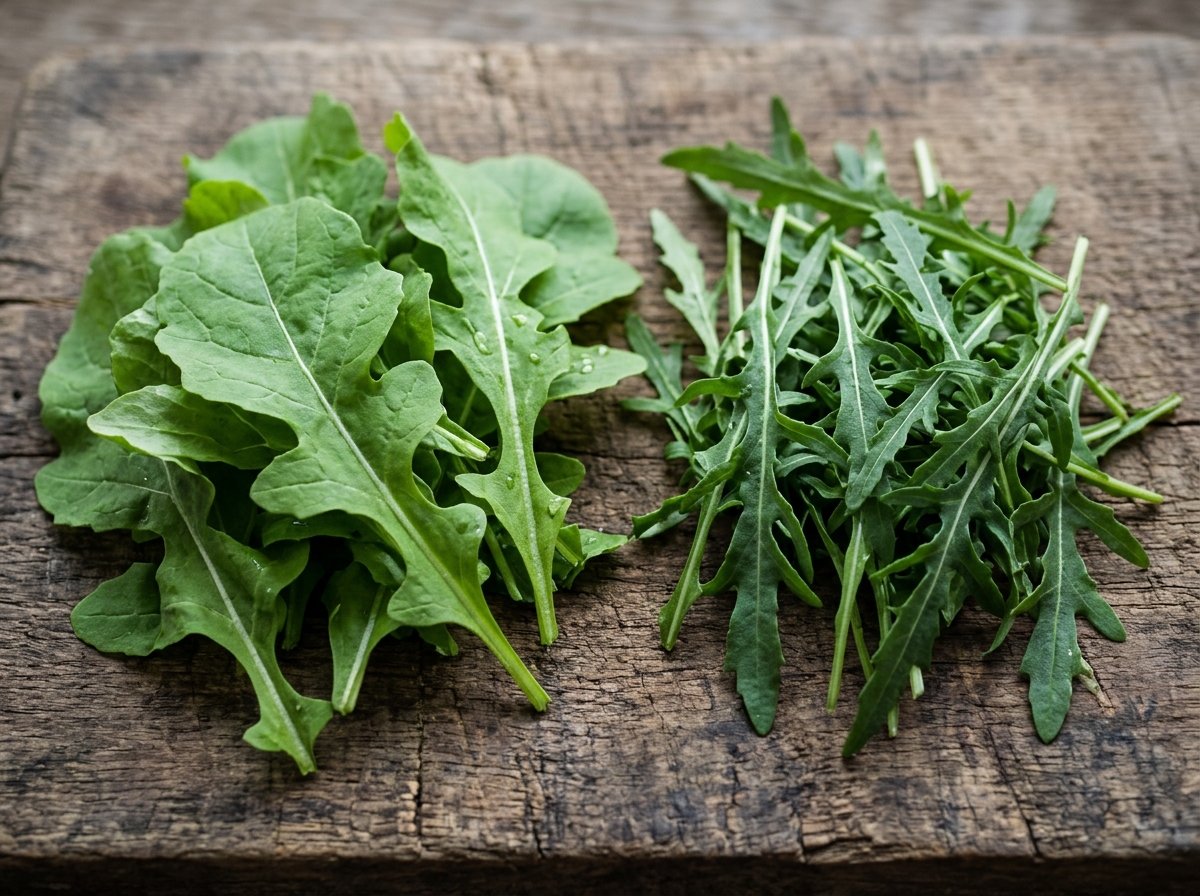
Two genera, one market name
"Rocket" on a seed packet or salad bag can refer to at least three plants. Salad or garden rocket is Eruca vesicaria subsp. sativa, an annual. Wild rocket is Diplotaxis tenuifolia, a short-lived perennial that can crop for two or more seasons in mild gardens. Wall rocket, Diplotaxis muralis, is a smaller annual relative occasionally sold under the same label. All three belong to the Brassicaceae, the family of cabbage, mustard and radish — a fact that matters for rotation and pest pressure.
In Italy the crop is rucola or rughetta, in France roquette, and in North America arugula, a name that entered American English from southern Italian dialect forms. The trade does not always separate the genera: bagged "wild rocket" is usually Diplotaxis, while bunched market rocket is more often Eruca.
Reading the leaf
- Leaf: Eruca leaves are broader, softer and lobed, typically 10–20 cm at maturity, with a rounded terminal lobe. Diplotaxis leaves are narrower, thicker and deeply cut.
- Flower: Eruca carries cream-white petals marked with dark purple veins. Diplotaxis flowers are clear yellow.
- Habit: Eruca forms a single rosette and bolts in one season. Diplotaxis builds a woody crown and resprouts after cutting.
- Seed: Eruca seed runs at roughly 500 per gram; Diplotaxis seed is far finer, around 4,000 per gram, which changes how thinly it must be sown.
Where the heat comes from
The peppery bite is chemistry. Rocket stores glucosinolates — sulphur compounds that break down into isothiocyanates when cells are crushed and the enzyme myrosinase is released. In Eruca the dominant compounds include glucoerucin and glucosativin; Diplotaxis profiles differ and are generally perceived as sharper. Concentrations rise with heat, drought stress and leaf age, which is why a July leaf from a dry bed tastes harsher than an October leaf from the same seed lot.
Cultivars worth knowing
Named selections narrow the variation. The register above lists seven that appear regularly in UK, EU and North American catalogues. 'Apollo' and 'Astro' are Eruca selections chosen for broader, milder leaves; 'Rucola Coltivata' is the standard Italian cultivated type. 'Sylvetta' and 'Olive Leaf' are compact Diplotaxis selections, 'Wasabi' is marketed for a horseradish-like finish, and 'Dragon's Tongue' adds purple-red veining. Catalogue descriptions are claims, not measurements: if heat level matters, grow two cultivars side by side in one bed and taste them on the same day.
A short documented history
Eruca is native to the Mediterranean basin and western Asia and has been grown for at least two millennia. Pliny the Elder discusses it in the Naturalis Historia (1st century CE); Columella's De Re Rustica treats it as a garden plant, and Dioscorides lists it in De Materia Medica. Around 800 CE the Carolingian Capitulare de villis included eruca alba among plants to be grown on royal estates.
Outside the salad bowl, Eruca seed is pressed for taramira oil in north-western India, notably Rajasthan, where the crop tolerates dry conditions. In Campania, "Rucola della Piana del Sele" received EU Protected Geographical Indication status in 2020, covering rocket from the Sele plain south of Salerno.
Choosing by use case
- Fast baby leaf in spring or autumn: Eruca, first cut in 21–35 days.
- Cut-and-come-again over months: Diplotaxis, first cut 35–50 days, then repeated cuts.
- Balcony containers: compact Diplotaxis selections tolerate irregular watering better.
- Milder mixed salads: broad-leaf Eruca cut young.
Next, File 02 covers how soil temperature and day length decide whether either type leafs up or runs to seed.