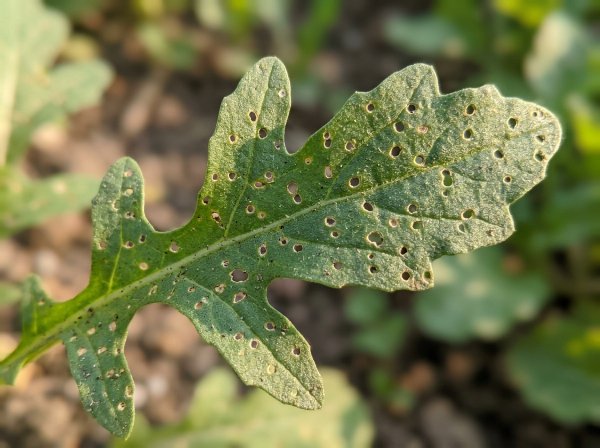
The flea beetle problem, quantified
Flea beetles (Phyllotreta spp., including P. cruciferae and P. striolata) are the primary pest of rocket in most temperate regions. Adults are 2–3 mm long, metallic black or black with yellow stripes, and jump when disturbed. Feeding leaves round shot holes 1–2 mm across. Established plants tolerate moderate damage, but seedlings at the cotyledon stage can be killed outright. Activity peaks in warm, dry, sunny weather from around 20 °C, which is why April–May and late-summer sowings in dry spells are most exposed.
Mesh: the numbers that matter
Physical exclusion is the most reliable control in a home garden. "Insect mesh" is not a single product: meshes with openings of about 1.3–1.4 mm stop cabbage white butterflies but not flea beetles. For flea beetles, use mesh with openings of 0.8 mm or finer.
- Cover immediately after sowing, not after damage appears; adults overwinter in nearby soil and leaf litter.
- Bury or weigh down the edges. A 2 cm gap is enough to let beetles in.
- Support the mesh on hoops so leaves do not press against it.
- Rotate beds: beetles emerging inside a covered bed of last year's brassicas are trapped with the crop.
Cultural measures
- Keep the soil surface moist; flea beetles favour dry conditions.
- Sow early in spring or after late August to avoid peak activity.
- Grow fast: well-watered, unstressed plants outgrow light damage.
- Remove brassica debris and cruciferous weeds such as shepherd's purse (Capsella bursa-pastoris), which host the beetles.
Other pests
Cabbage aphid (Brevicoryne brassicae) forms grey, waxy colonies on leaf undersides, mostly from midsummer. Squash small colonies by hand or remove affected leaves; ladybird and hoverfly larvae often clear the remainder. Slugs, particularly the grey field slug Deroceras reticulatum, attack seedlings in wet weather; evening checks with a torch give a real count rather than an impression. Caterpillars of the small white butterfly (Pieris rapae) and diamondback moth (Plutella xylostella) appear occasionally; the same fine mesh excludes them.
Diseases
Downy mildew, caused by Hyaloperonospora species, shows as yellow patches on the upper leaf surface with grey-white growth beneath. Cool, humid nights and crowded rows favour it. Space plants, water in the morning and remove infected leaves promptly. Damping-off (Pythium and related organisms) collapses seedlings at soil level; use clean containers and fresh compost, and avoid overwatering. Clubroot is covered under rotation in File 02.
Chemical controls: read the label
Rules differ by country and change often. In the UK a product must be authorised for the specific crop; rocket may fall under a broader leafy-crop category on the label, or not appear at all. Check the label and your national regulator — in Great Britain, the HSE Chemicals Regulation Division — before applying anything, and observe the stated harvest interval.
A simple monitoring routine
- Days 0–14 after emergence: inspect daily; count holed seedlings per 1 m of row.
- Weeks 3–6: check twice weekly, including leaf undersides.
- After each cut: look for aphid colonies on regrowth.
Record dates, temperatures and counts. After one season you will know your local peak weeks, which is more useful than any national average. Harvest timing and handling continue in File 04.